


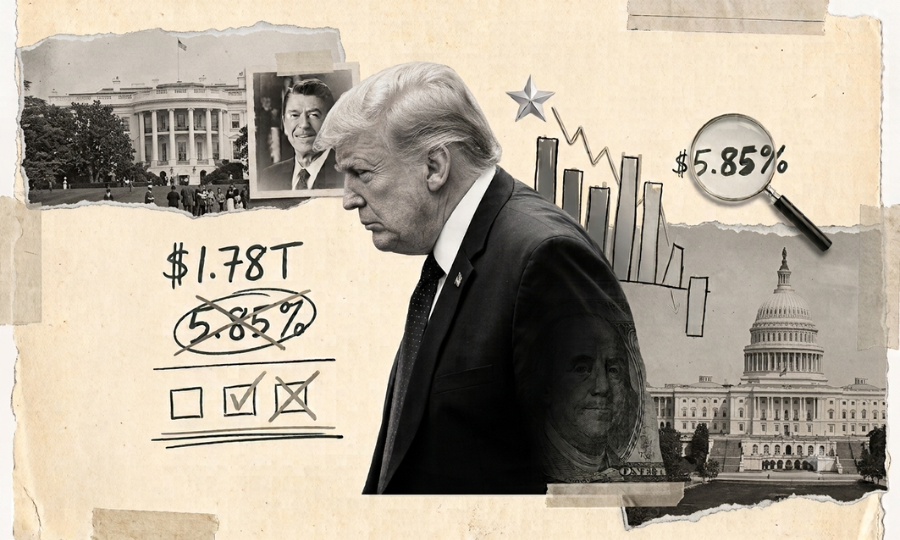
An Itempnews investigation found that the most favorable fiscal result of the president’s first year benefited from extraordinary tariff revenue and an accounting adjustment. Without both effects, that figure would have been notably higher than reported.
Carlos Tagliafico contributed reporting from Atlanta. Frank Lopez Ballesteros contributed reporting from Miami.
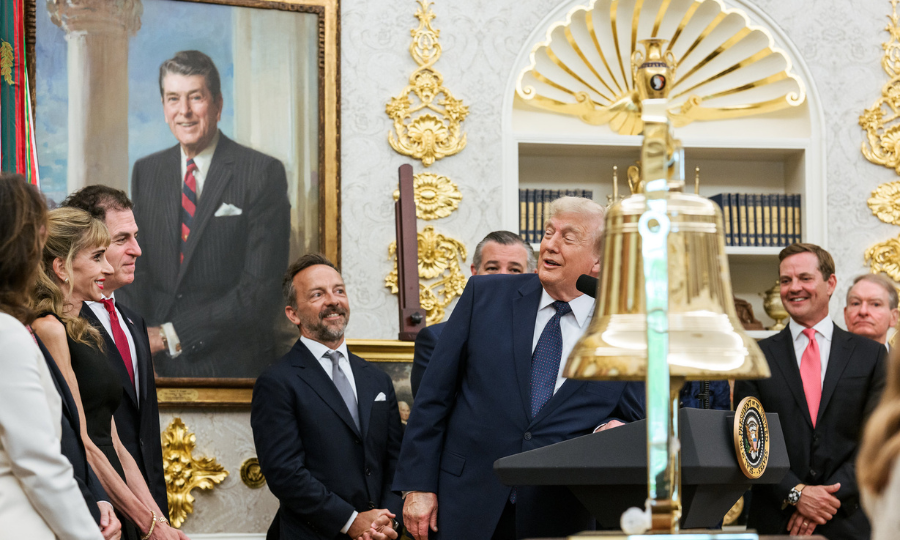
In the Oval Office, next to the Resolute Desk, Donald Trump hung a portrait of Ronald Reagan, the president who made tax cuts, deregulation and faith in growth the pillars of Republican economic policy. But the numbers behind the start of the current president’s second term tell a less triumphant story: federal revenue has not grown fast enough to keep pace with spending.
There is, however, a decisive difference: when the deficit grew, Mr. Reagan partially reversed course with tax increases in 1982, 1983 and 1984. The current president, by contrast, made the 2017 tax cuts permanent and added new ones, without a comparable correction.
An Itempnews investigation based on official figures from the U.S. Department of the Treasury and the Congressional Budget Office found that fiscal year 2025 closed with a deficit of $1.78 trillion, equivalent to 5.85% of GDP. Among the first fiscal years tied to administrations over the past four decades, only Barack Obama’s was higher, in the depths of the Great Recession. The comparison, however, has a limit: the fiscal year was already more than three months underway when Mr. Trump took office.
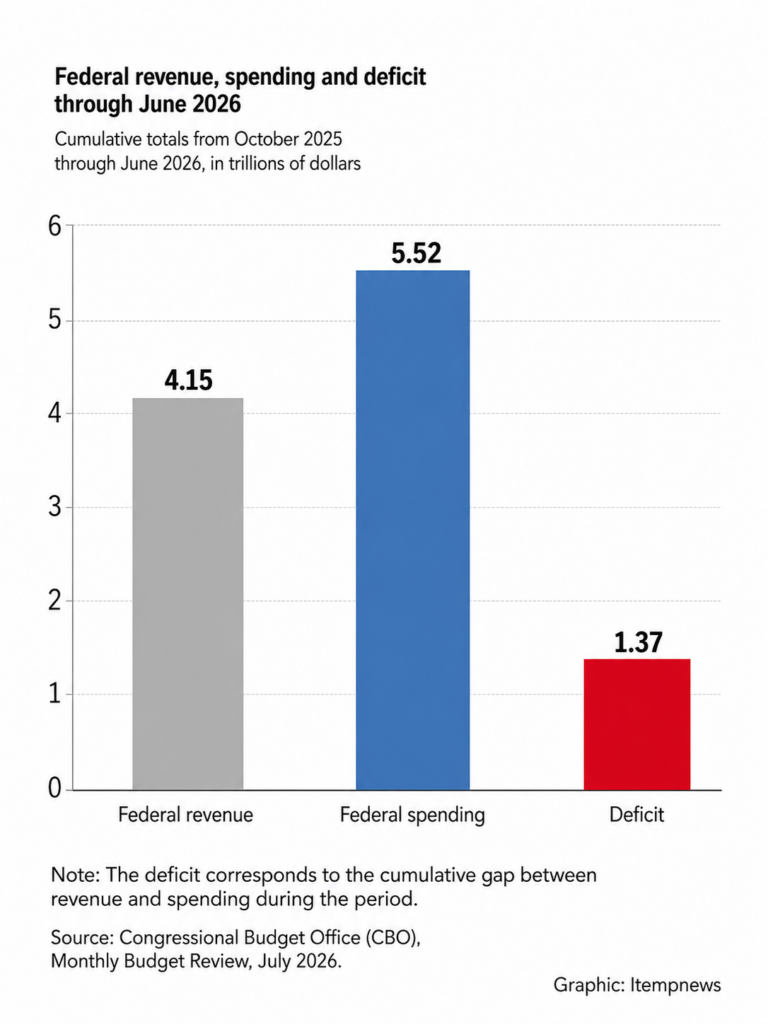
Fiscal year 2026, the first to run entirely under the second Trump administration, likewise shows no reduction in the deficit. Between October 2025 and June 2026, the federal government accumulated a $1.37 trillion deficit, $35 billion more than during the same period a year earlier.
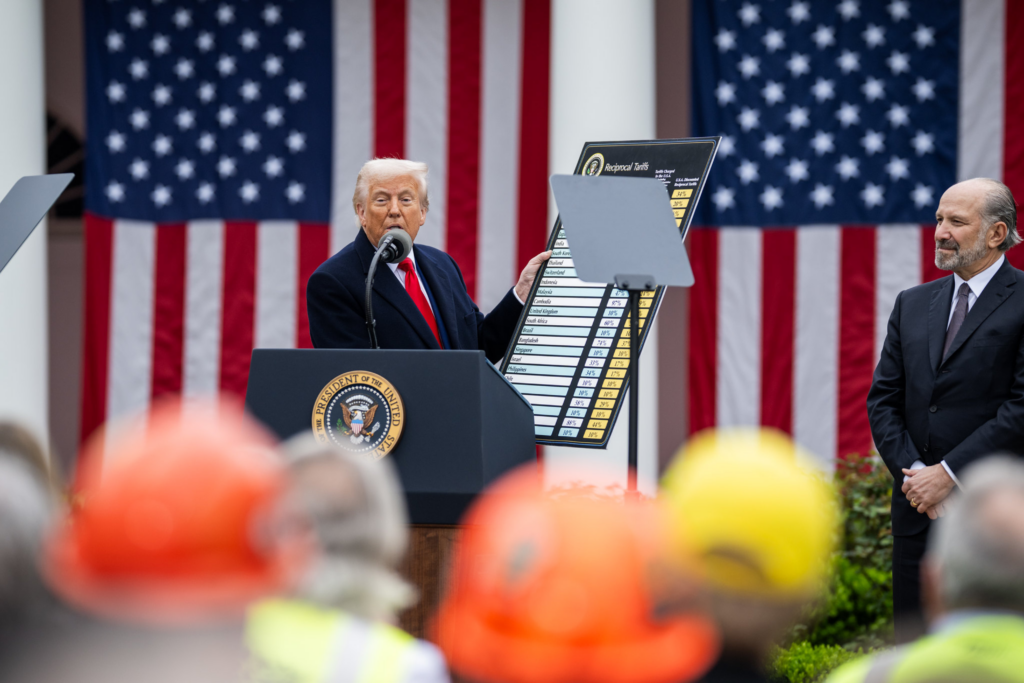
Part of the increase in federal revenue, however, depends on a legally unstable tariff policy, propped up in recent months by a succession of court rulings and changes in legal authority.
For this report, Itempnews separately consulted economists from different economic and ideological schools of thought. Although they disagreed on causes and possible solutions, their responses converged on a common warning: the deficit will keep growing, and the administration’s policies do not, for now, offer a sufficient path to contain it.
Fiscal year 2026 also coincides with a central test of one of the promises behind Mr. Trump’s return to the White House: lowering the cost of living. In June, inflation eased to 3.5% year-over-year, down from 4.2% in May. But the relief was partial: energy prices were still 15.7% higher than a year earlier, and gasoline was hovering around $4.05 a gallon on average nationwide, according to the EIA.

The Numbers Already In
Comparing Mr. Trump’s deficit with those of his predecessors looks like simple subtraction. It isn’t. For the comparison to be valid, every administration must be measured at the same point in the fiscal calendar, and that is where a decisive complication appears.

The federal fiscal year begins on October 1, more than three months before a new president takes office. That means fiscal 2025 was already 111 days underway when Mr. Trump returned to the White House, and it cannot be attributed entirely to his administration.
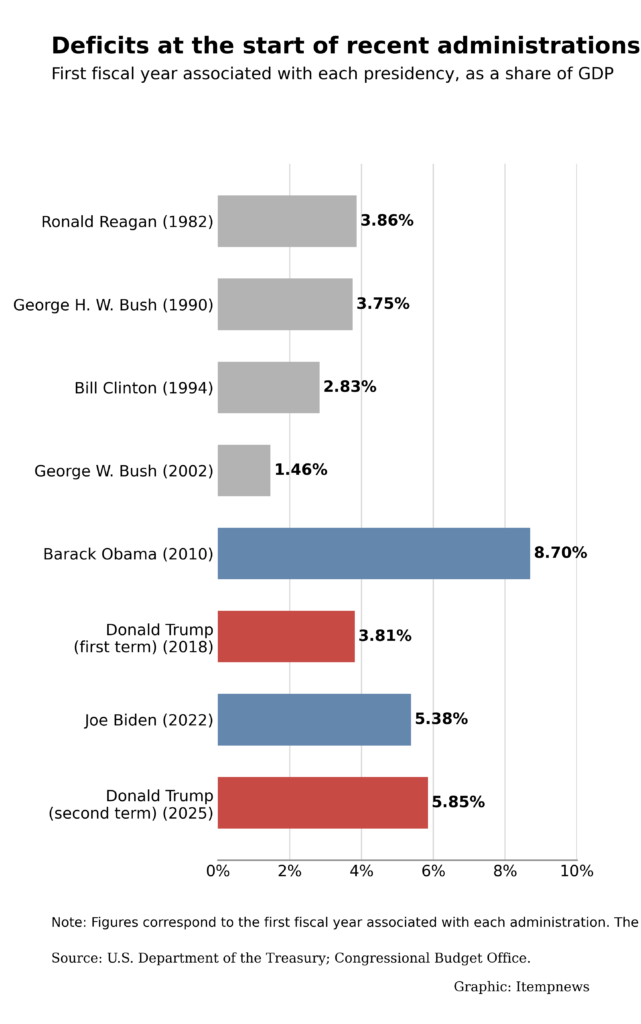
Even with that caveat, the 2025 deficit is far above those recorded at the start of most recent administrations. Mr. Reagan opened with a deficit equal to 3.86% of GDP in 1982; George H. W. Bush, 3.75% in 1990; Bill Clinton, 2.83% in 1994; George W. Bush, 1.46% in 2002; and Mr. Trump, during his first term, 3.81% in 2018.
Only Mr. Obama and Joe Biden posted comparable or higher figures: 8.70% of GDP in 2010, as the United States was just beginning to climb out of its worst economic crisis since the 1930s, and 5.38% in 2022, under the fiscal weight of the pandemic.
The pattern is hard to ignore: except for Mr. Obama, no president in the last four decades has been tied to a deficit this high at the start of his term without the country going through a major economic crisis. Not even Mr. Reagan, whose first fiscal year coincided with a recession and unemployment above 10%.
The comparison helps put the deficit in perspective, but it is not enough to judge a president’s fiscal responsibility. Jessica Riedl, a budget analyst at the Brookings Institution and a former adviser to Republican lawmakers and campaigns, wrote in an email to Itempnews that “the first year of a new presidency is not very useful to assessing their fiscal record.”
“The better way to measure a president’s fiscal record is by the spending and tax policies that are signed into law or done through executive order,” Ms. Riedl added.
Fiscal 2026 So Far
Partial 2026 data likewise show no sustained improvement.
The improvement that was still visible in May, according to the Treasury’s monthly statement, had vanished entirely by June.
Federal revenue rose to $4.15 trillion, an increase of $142 billion over the prior year. Tariff collections accounted for $55 billion of that increase. But spending grew even more, reaching $5.52 trillion, $178 billion higher, driven mainly by Social Security, Medicare and Medicaid.
The year-over-year comparison is also distorted by the calendar. The Congressional Budget Office estimates that, without the shift of a payment that fell on a weekend in 2025, the deficit would have grown by an additional $56 billion.
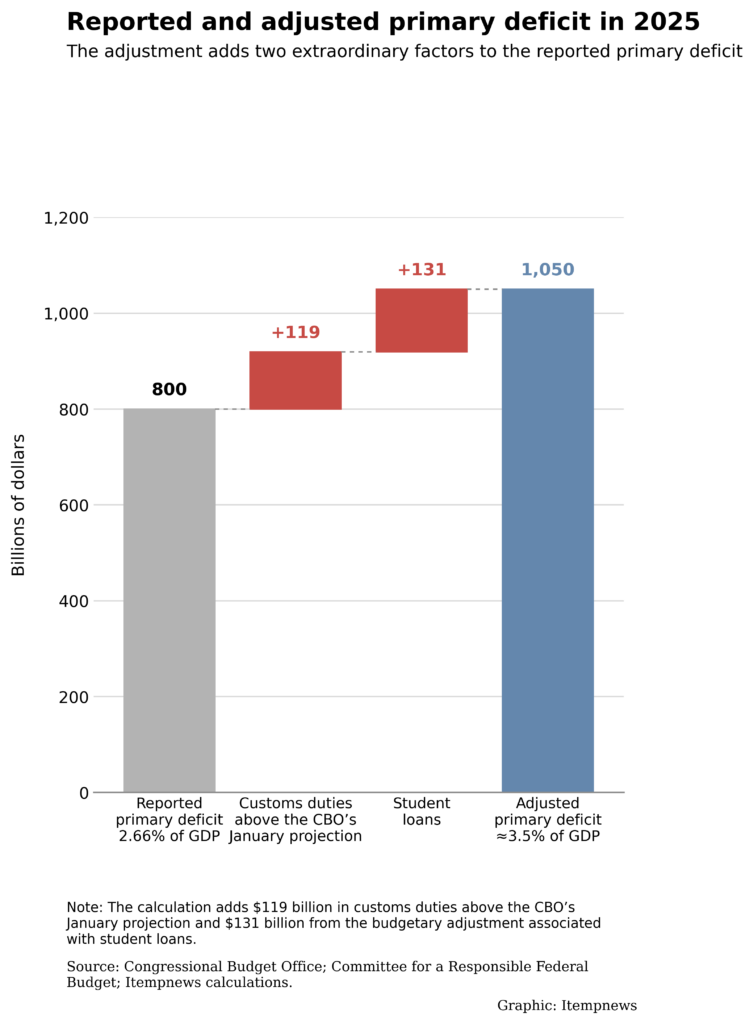
There is another figure that, without context, can look more favorable than it is. The primary deficit (the gap between revenue and spending, excluding interest on the debt) closed fiscal year 2025 at roughly $800 billion, equivalent to 2.66% of GDP. That was lower than the figure recorded at the start of the Obama and Biden administrations.

But an Itempnews analysis found that this apparent improvement benefited from two extraordinary factors.
The first was a sharp jump in customs revenue, driven by the new tariffs that Mr. Trump made a central part of his second-term economic policy. In 2025, the government collected $195 billion in customs duties, compared with the $76 billion that the CBO had projected in January, before the new tariffs — $119 billion more than expected.
The second was a $131 billion reduction in recorded spending, stemming from changes that Mr. Trump’s sweeping tax-and-spending law made to federal student loan programs. Budget accounting recorded in 2025 the estimated value of effects that will extend over years, meaning that reduction will not recur annually.
Adjusting for both effects to approximate the recurring fiscal balance, the primary deficit would have been closer to 3.5% of GDP, according to a calculation made for this report.

That adjustment lines up with an analysis by the Committee for a Responsible Federal Budget: the student loan changes gave the 2025 deficit a one-time reduction, before the bulk of the law’s budgetary cost begins showing up in the accounts. The committee estimates the law will add roughly $500 billion to the deficit in 2026 and $635 billion in 2027.
Itempnews requested comment from the Treasury Department on this finding. It did not respond.
A Prop on Shaky Ground
The deficit would have been larger without the jump in tariff revenue. But that relief depends on a policy whose legal basis has been challenged and rebuilt on the fly.
An Itempnews analysis of Treasury data found that customs revenue rose more than 130% in fiscal year 2026 compared with the same period a year earlier. That revenue partially held down the growth of the deficit.
The fragility of that revenue was exposed on February 20, when the Supreme Court struck down tariffs imposed under the International Emergency Economic Powers Act. The administration had to turn to a different legal authority to keep them in place.
The ruling also opened the door to refunds, with interest, of tariffs collected under that authority. By August 5, the government had already refunded roughly $100 billion, out of a total of $166 billion collected under that law, according to a declaration filed with the U.S. Court of International Trade. By August, the Treasury itself was already adjusting its customs revenue figures to account for those refunds.
Mr. Trump responded by invoking Section 122 of the Trade Act of 1974 and temporarily imposed a 10% tariff on nearly all imports. But the administration’s use of that authority was also struck down on May 7 by the Court of International Trade. The administration appealed, and the tariffs remained in effect until they expired on July 24.

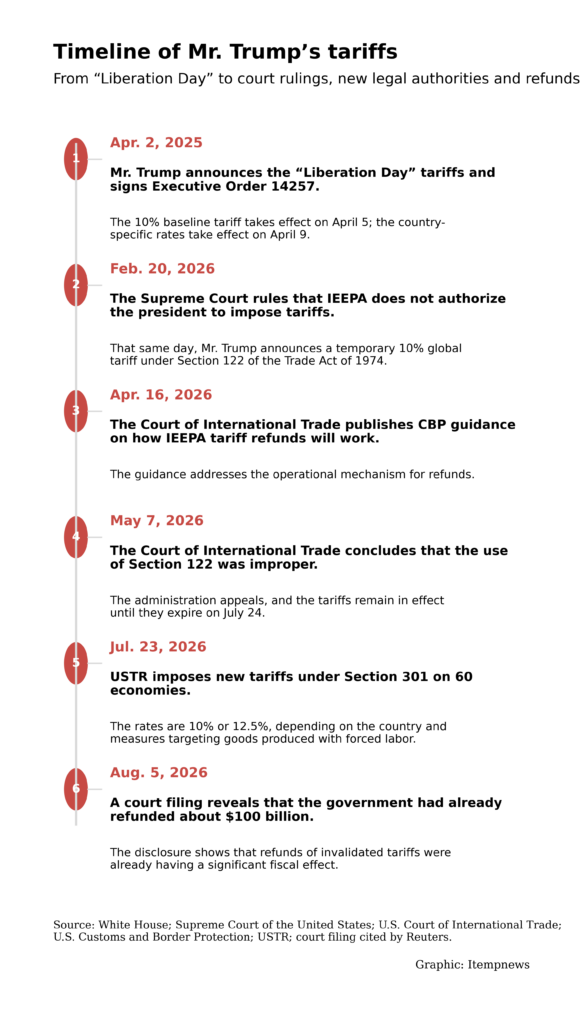
When the measure expired, the administration replaced it with new tariffs under Section 301 of the Trade Act of 1974. The duties, ranging from 10% to 12.5%, applied to 60 trading partners that account for 99.4% of U.S. imports.
Legal instability over tariffs was not the only setback for the fiscal agenda. Elon Musk, the world’s richest person, promised that the Department of Government Efficiency (DOGE) would save up to $2 trillion. The initiative ceased operations on July 4.


A Government Accountability Office report, published August 6, found that more than half of the $61 billion in contract savings DOGE claimed could not be verified, and that 96% of the savings attributed to grants did not follow its stated methodology.
What Bears His Signature
Beyond the back-and-forth over tariffs, there is one fiscal decision that bears Mr. Trump’s signature directly: the sweeping tax-and-spending law he signed on July 4, 2025, known as the One Big Beautiful Bill Act.
Measured by that standard, the law does not improve the fiscal balance either. Ms. Riedl, the Brookings economist, called it “very expensive and fiscally irresponsible” and said tariffs offset only a small share of its cost.
The Congressional Budget Office estimates the law will add $3.4 trillion to the deficit over the next decade.
In their responses to Itempnews, Moody’s Analytics economists Brendan La Cerda and Mark Zandi put the imbalance in perspective. Mr. La Cerda calculated that tariffs would bring in roughly $200 billion in additional revenue a year against deficits nearing $2 trillion. Mr. Zandi cautioned that even that revenue would not be permanent.
Moody’s projects that tariffs will revert to earlier levels once Mr. Trump’s term ends, and that the deficit will widen from 6% of GDP in 2026 to 7.9% in 2028 and 9.1% in 2034, as the tax cuts curb revenue growth.
The same law that will widen the deficit also cuts spending on Medicaid and other assistance programs. The Congressional Budget Office estimates its Medicaid provisions will leave 7.5 million more people uninsured by 2034, and that, taken together, the law will reduce resources for families at the lower end of the income scale.
The pressure to cut health spending will also reach Medicare. The administration will let expire at the end of 2026 a temporary program that had helped hold down premiums for standalone Part D drug plans. The government argues the subsidy benefited insurers excessively; its elimination could raise costs for some of the roughly 25 million beneficiaries enrolled in those plans starting in 2027.
The Weight No One Chose
It would be unfair to attribute the entire deficit to this administration. Part of it stems from obligations accumulated over decades and will keep straining federal finances no matter who is in power.
The weight of that inheritance is clearest in interest payments on the debt. In fiscal year 2025, they topped $1 trillion for the first time and already exceeded defense spending, a crossover that first occurred in 2024. So far in 2026, interest payments remain, along with Social Security and Medicare, one of the main drivers of rising spending.
Cuts or restrictions on specific programs can reduce certain federal expenses, but they don’t eliminate the structural pressure that health care costs place on federal finances. Kent Smetters, director of the Penn Wharton Budget Model, a nonpartisan fiscal analysis project at the University of Pennsylvania, told Itempnews that the biggest long-term risk to federal finances is the growth of health care costs.
If that trend continues, Mr. Smetters calculated, the country could face serious fiscal problems in under 20 years. But he cautioned that this timeline is only an outer bound: “Things can unravel much faster than that.”
No Easy Verdict
Mr. Bush inherited a surplus that disappeared after the 2001 recession, the September 11 attacks and the wars that followed. Mr. Obama took office in the depths of the Great Recession; Mr. Biden took office amid the fiscal costs of the pandemic. President Trump returned to the White House without a comparable economic emergency. Even so, the first fiscal year tied to his new administration came in higher than all of his predecessors’ except Mr. Obama’s.
Douglas Holtz-Eakin, president of the American Action Forum, a conservative think tank, and a former director of the Congressional Budget Office, explained in an email to Itempnews that no single metric is enough to gauge the country’s fiscal health. All of them, however, point to the same diagnosis: “The problem for the U.S. is that they all indicate problems,” he wrote.
Mr. Holtz-Eakin also argued that Washington has lost the political capacity to respond to fiscal deterioration. In the 20th century, he explained, a rising deficit tended to generate pressure to fix it; “there is no such response in either party today.” He warned that only a major crisis, such as the exhaustion of the Social Security trust fund, could make a response unavoidable.
Mr. Trump inherited costly debt and obligations that no president can change overnight. But the first fiscal year to run entirely under his administration shows no change in trajectory either: through June, the deficit exceeded that of the same period a year earlier; tariffs generated extraordinary revenue, but that revenue stream may not last; and the tax law that bears his signature will widen the imbalance over the next decade.
Itempnews also requested comment from the White House on this trajectory, but received no response.
The comparison with his predecessors does not justify attributing every dollar of the deficit to Mr. Trump. But it does leave a difference that is hard to ignore: the largest imbalances at the start of other presidencies came alongside major economic or national crises. Mr. Trump’s did not, and the policies that already bear his signature have not changed the fiscal trajectory.
| Methodology The main fiscal figures in this report come from primary federal government sources: the Treasury Department’s monthly statements and financial report, the Debt to the Penny database, Congressional Budget Office reports, and data series from the Federal Reserve Bank of St. Louis. Inflation and unemployment data come from the Bureau of Labor Statistics. The adjusted primary deficit cited in this report is Itempnews’s own calculation, not an official CBO figure. The calculation adds to the reported primary deficit the $119 billion in customs revenue above the CBO’s January projection and the $131 billion budgetary adjustment tied to student loans. Itempnews used AI tools to verify complex mathematical calculations, compare fiscal data series and develop visualizations based on official data. The results were verified against the primary sources. Artificial intelligence was not used as a source of information, nor did it replace journalistic verification or the writing of the report. |
This story was translated from Spanish with the help of a generative artificial intelligence tool. An Itempnews digital editor reviewed the translation.