

In a single year, the government filed more than 56,400 motions to reactivate cases involving asylum applications and move them toward a decision, as asylum approval rates continue to fall.
Immigration officials denied the asylum application of Mercedes Gómez and her family in June, six months after she was finally interviewed in December 2025. The decision came after more than 11 years of waiting for that interview, upending a life built through years of sacrifice in the United States, where the youngest of her three children was born just months after their arrival.
Gómez, a Venezuelan from Maracaibo, her country’s second-largest city, has called Miami home since 2014. Now, the cost of appealing her case in immigration court is draining what remains of her finances. She sold her car, exhausted her savings and borrowed as much as she could to hire a new lawyer to represent her.
The Gómez family’s case is one example of a much broader trend. An Itempnews investigation found that, in a single year, President Donald Trump’s administration filed more than 56,400 motions to put immigration cases that had been administratively closed back on court calendars. Each involved an asylum application. The surge in motions preceded another sharp drop: The asylum approval rate in immigration courts fell to a record low of 5.5% in June 2026.
The push reflects the government’s decision to move cases that had been suspended for years toward a resolution, expanding the pool of immigrants whose proceedings could end in a deportation order, experts say.
Asylum seekers and other immigrant communities now face sweeping changes to the rules as the White House restricts immigration and accelerates deportations. Venezuelans face an additional legal consideration: Political changes in their home country may be weighed in determining whether they still have a well-founded fear of persecution.
An Itempnews analysis of public case records from the Executive Office for Immigration Review, the Justice Department agency that oversees immigration courts, found a sharp increase in three types of motions filed in proceedings involving asylum applications.
Motions to reopen, which allow a case to be revisited after a decision to consider new facts or evidence, rose from about 10,700 in fiscal 2024 to 17,100 in 2025, an increase of nearly 59%. Motions to reconsider, which seek a review of a decision for possible errors of fact or law, increased from about 900 to 1,600.
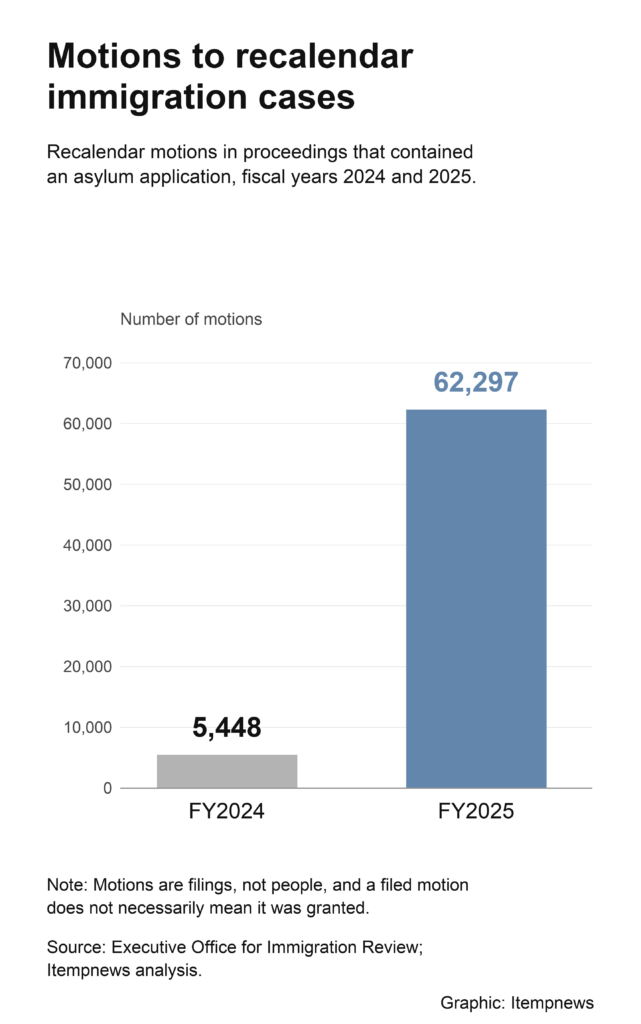
The sharpest increase, however, was in motions to return administratively closed proceedings to court calendars, known as motions to recalendar. Those rose from about 5,450 in 2024 to 62,300 in 2025 — more than elevenfold in a year. Of those, more than 56,400, or nine in 10, were filed by the Department of Homeland Security.
In practice, the agency was asking immigration courts to restart tens of thousands of proceedings in which an asylum application had been filed. According to the Executive Office for Immigration Review, administrative closure temporarily suspends a case without resolving it. The mechanism has been used for various reasons, including to allow someone to pursue another immigration benefit in the United States.
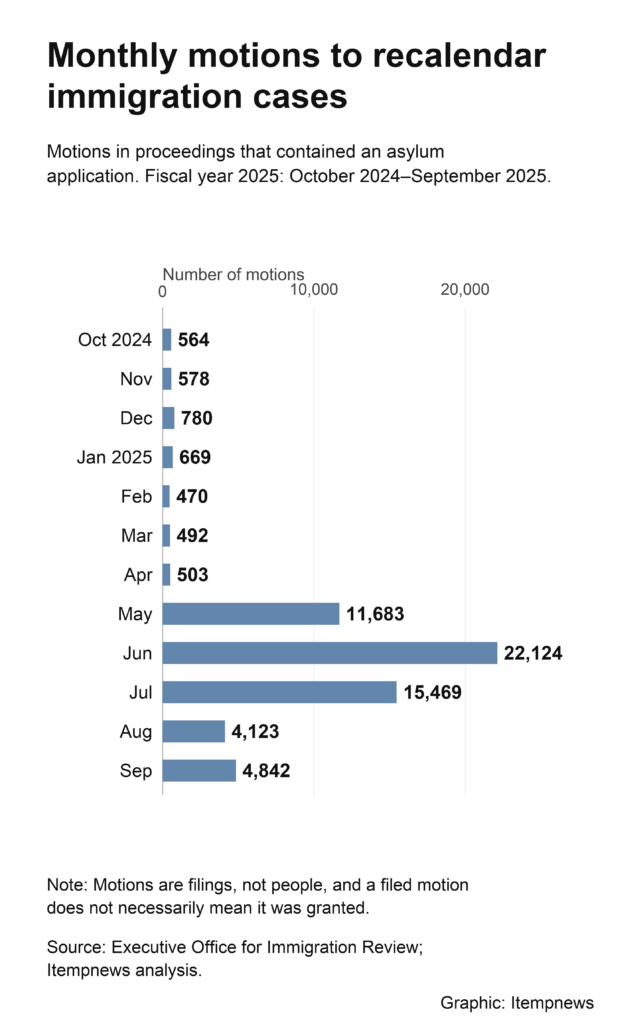
Immigrant legal advocacy groups documented that, beginning in May 2025, DHS sought to reactivate these proceedings on a large scale, including some that had been suspended for years.
The increase was concentrated between May and July 2025, when about 49,300 motions to return cases to court calendars were recorded. The surge coincided with the early months of the Trump administration’s deportation campaign and an expansion of immigration enforcement operations by DHS, then led by Secretary Kristi Noem.
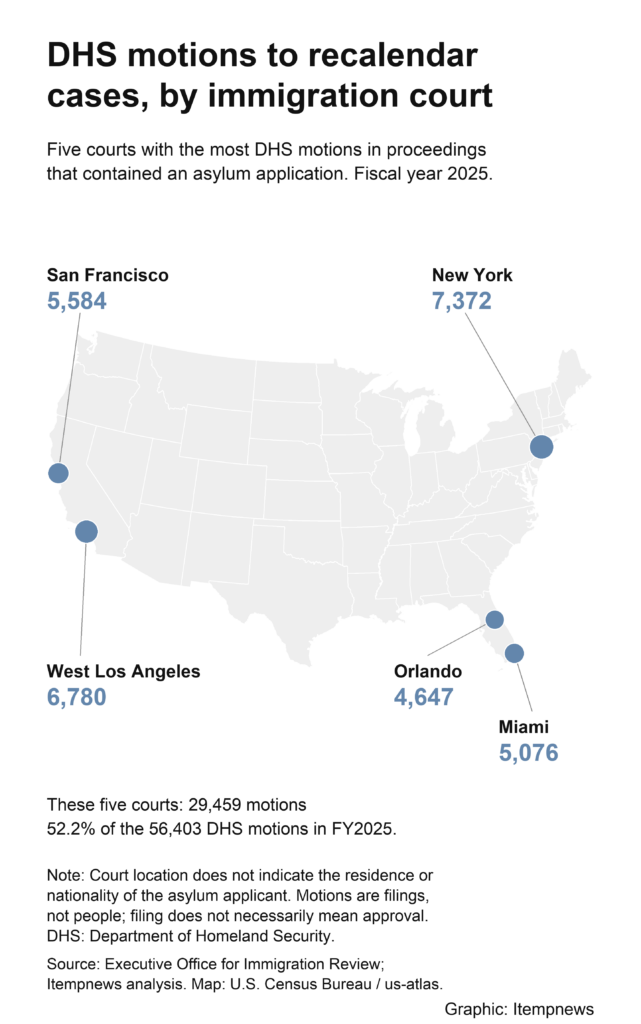
The activity was also concentrated in certain courts. New York, West Los Angeles, San Francisco, Miami and Orlando accounted for more than half of the motions filed by DHS in fiscal 2025. In Florida, the Miami and Orlando courts alone accounted for about 17% of the total. The figures reflect the location of the court, not the applicants’ residence or nationality.
A broader review
The federal government’s efforts extend beyond administratively closed cases. DHS is also appealing asylum grants, asking the Board of Immigration Appeals to review judges’ favorable rulings and determine whether they should stand, be overturned or be reconsidered.
Itempnews identified at least nine such cases among precedential decisions published in 2026. They involved applicants from Venezuela, Afghanistan, Nicaragua, Russia, Burkina Faso, Jamaica, Mexico and Morocco, as well as a woman born in Tajikistan who holds Russian citizenship.
Colleen Putzel-Kavanaugh, a policy analyst at the Migration Policy Institute in Washington, warned that reviewing previously approved or closed cases adds to the workload of a system with limited staff and resources.
“Resources and people-power are finite,” she said. “Reopening previously approved or closed cases adds additional workload, but is certainly feasible, with the tradeoff being slow downs for other types of processing.”
The total number of asylum grants challenged by the government is unknown. The nine identified cases are limited to decisions the appeals board designated as published precedents and therefore do not necessarily represent the full scope of appeals.
One case involved a Venezuelan woman whom a judge had granted asylum in April. DHS appealed, and the board vacated the decision and sent the case back to the immigration court to reconsider her fear of persecution in light of political changes in Venezuela following Nicolás Maduro’s capture by U.S. forces in January 2026 and his departure from power.
The challenges extend to other forms of protection. In August, the government took less than 24 hours to overturn protection from deportation granted under the Convention Against Torture to José Serrano, a former Ecuadorian minister. About five hours after the appeals board’s decision, Serrano was deported to Ecuador, according to The New York Times.
U.S. Citizenship and Immigration Services also ordered a review of certain immigration benefits that had already been approved, including asylum cases. A federal judge struck down the policy in June, but an appeals court allowed the review to continue in August while the litigation proceeds.
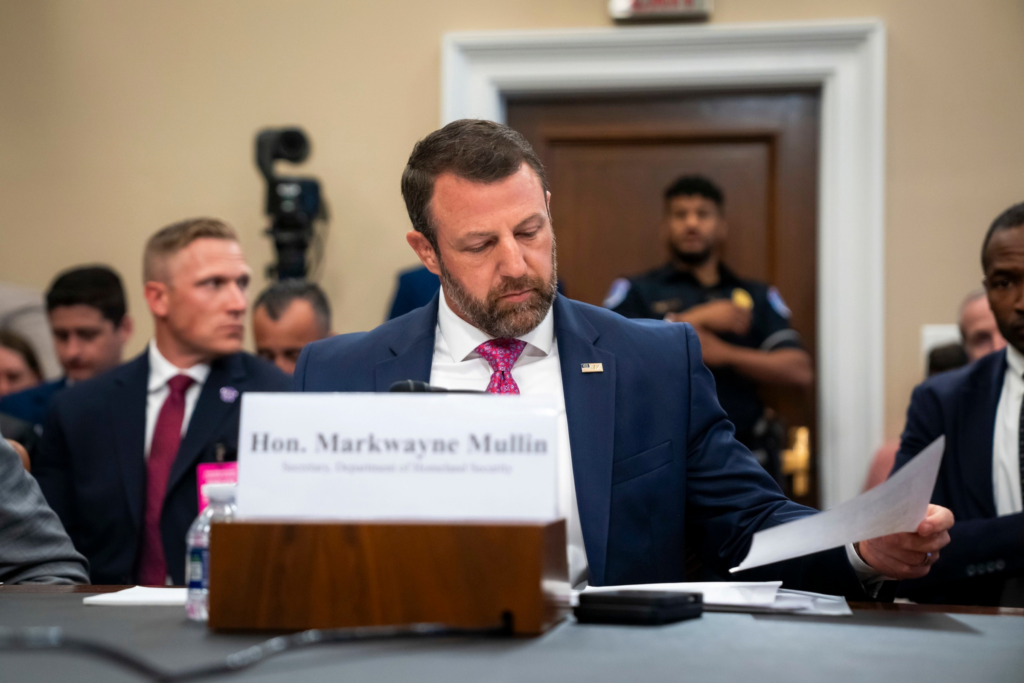
A Department of Homeland Security spokesperson did not answer Itempnews’ specific questions about the review of asylum grants. In an emailed statement, the spokesperson said: “President Trump and Secretary (Markwayne) Mullin are now enforcing the law, including by ensuring asylum applications receive appropriate legal review. The Board of Immigration Appeals exists, in part, to prevent meritless asylum applications from slipping through the cracks.”
The toll of uncertainty
As the government reactivates and reviews cases, asylum approval rates in immigration courts have reached record lows. In June, judges decided more than 14,000 cases, but only 771 people received protection an approval rate of just 5.5%, according to data from Syracuse University’s TRAC research project.
The decline began before the current administration. TRAC found that the approval rate, which exceeded 50% at the start of the Biden administration, had fallen to 32% by the end of his presidency. Under Trump, the decline continued and accelerated, reaching 5.5% in June.
Putzel-Kavanaugh said the government has adopted “a broad view of the statute’s mandatory detention policy,” extending it even to people whose immigration applications have been pending for years.
She added that many of the administration’s policy changes reflect a push to increase “self-deportations.” Prolonged detention, “especially in reportedly subpar conditions,” has led some people to leave the country rather than remain in custody indefinitely, she said.
The new precedent could have far-reaching implications for Venezuelans. In fiscal 2024, Venezuela ranked third by total number of asylum cases in immigration courts, behind Honduras and Guatemala. The Executive Office for Immigration Review recorded 28,647 Venezuelan cases that year, nearly seven in 10 of which remained undecided at the end of the period.

For other Venezuelan asylum seekers, uncertainty persists even after their interviews. Gabriela Pérez, whose name was changed to protect her identity, is a former employee of Venezuela’s Ministry of Justice who arrived in the United States in 2016. In January 2026, after a decade in the country, USCIS interviewed her about her asylum application. Eight months later, she is still waiting for a decision.
The delay has left Pérez in a constant state of anxiety. Speaking by phone from her home in Doral, west of Miami, she said stepped-up Immigration and Customs Enforcement operations in the area had transformed her daily life. Fear of being detained, she said, has led her family to limit outings and spend most of their time at home.
“We’ve stopped taking our children even to a park or going to the supermarket as a family because we could be arrested. Our life isn’t normal anymore. I feel like a criminal,” Pérez said in an interview.